Showing posts sorted by relevance for query l-methylfolate. Sort by date Show all posts

Saturday, August 27, 2011

Folate! The Beginning.

Did I ever mention that I'm not a big fan of the folate cycle?  Not because it's not important, but because it is intensive, poorly understood, and hard to remember.  Probably a bad reason to dislike it, as far as those things go…

Let's just start with a diagram, and an explanation for those of us who were taught some basic organic chemistry.  Folate does not equal folic acid.  I know.  It's weird.  For all the other acids, -ate equals -ic acid (such as phytate and phytic acid), but for whatever reason, folate = dihydrofolate, and folic acid equals synthetic folate that is used to fortify foods in the US and in multivitamins.  Let me supply you with a handy diagram:
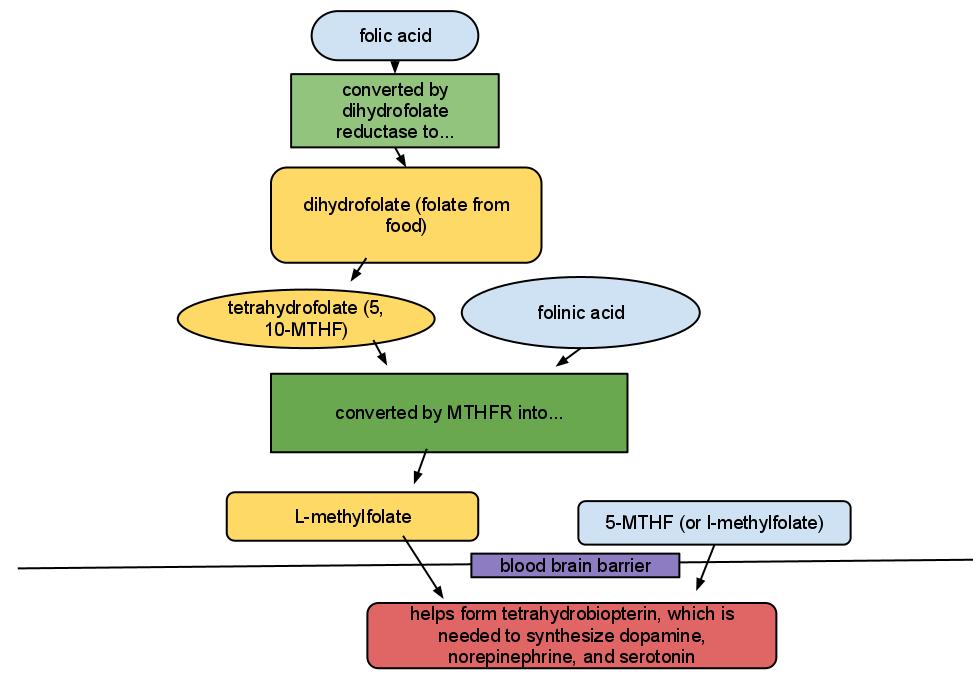
Please click on the diagram to make it bigger!
The blue formulations are those that can be had by prescription or supplement.  The yellow are the natural forms.  Folic acid is put into grains and multivitamins.  Folinic acid is used in chemotherapy.  5-MTHF (methyltertrahydrofolate, or the active enantiomer l-methylfolate) is a "medical food" pharmaceutical grade folate one can get by prescription.

Now why would a psychiatrist care about this pathway?  Well, folks with depression have increased risk of having crappy dihydrofolate reductase activity (meaning they have a hard time turning synthetic folic acid into dihydrofolate - this enzyme is also inhibited by the medication lamotrigine).  In addition, folks with depression are more likely to have issues with the MTHFR enzyme (I know - it stands for methylenetetrahydrofolate reductase but that's not what I call it in my head either).  So if you prescribe medications meant to maximize the efficiency of neurotransmitter* transmission in order to treat depression or anxiety, or if you just want nature to maximize the efficiency of neurotransmitter transmission (which everyone would agree is preferable, if possible), you want plentiful tetrahydrobiopterin in the brain.

You can see from the diagram that cheap, plentiful folic acid may not aways become the final active product in the brain.  You can also see that expensive, prescription 5-MTHF (deplin) might be useful for some people, though you may be annoyed if you know that deplin has never been tested head to head against folic acid.

5-MTHF and folinic acid have had some decent studies increasing response rates to antidepressant therapies, and decreasing cognitive symptoms of depression.  The results for folic acid supplementation itself have been mixed.  And, given some genetic polymorphisms (such as C677T, affecting the MTHFR gene), a peripheral folate level (which I have drawn routinely) will not necessarily tell us about folate levels in the brain.

But why not just pour tons of folic acid into the system - well folic acid has some risks.  For one, it has been shown to mask some of the first symptoms of B12 deficiency (which I have seen - none of my patients with low B12 have had the classic hemotologic signs that doctors have long relied upon to help diagnose B12 deficiency - possibly because folic acid supplementation is now abundant in the food system).  In addition, folate is a growth factor, and one has to be careful about pouring growth factors into the system, lest one risk cancer - the risk of colorectal cancer being the most studied and the most likely (1) caused by widespread folic acid supplementation. (The results of the epidemiological studies are mixed however, with this large US study showing no correlation).

Now, if you take a ton of folic acid (more than 800 mcg daily - 800 mcg being the normal dose in prenatal vitamins), it has been shown that the excess folic acid won't be metabolized, and that excess folic acid in the serum actually reduces the amount of l-methylfolate that reaches the brain, with a potential increase in depression.   Supplementation with l-methylfolate will not mask B12 deficiency and is less likely to be a risk for colon cancer (since the upstream agent, folinic acid, is used to kill cancer).  But… the cost.  A thirty day supply of deplin can cost as much as $80 at the pharmacy, and the cheapest I have found it is $70 for a 3 month supply direct from the manufacturer.  As a "medical food" it is not covered by insurance.  And yes, in my clinical experience, I have some patients who have not responded to folic acid supplementation who have done very well on deplin.

Folate, real, natural happy dihydrofolate from food is most plentiful in leafy green vegetables, fruits, and (ahem) legumes.  Cereals and grains are fortified with synthetic folic acid.

Hopefully this article will clarify some things… or maybe we will consume  few more leafy green veggies and fruit along the way...

*serotonin, dopamine, and norepinephrine are neurotransmitters

Fava, M and Mischoulon, D. Folate in Depression: Efficacy, Safety, Differences in Formulations, and Clinical Issues.  J Clin Psychiatry 2009;70[suppl 5]:12-17

Frankenburg, FR, Folate supplementation: is it safe and effective? (letter) J Clin Psychiatry.  2008;69(9):1352-1353

Saturday, December 15, 2012

Alternative Therapies and Bipolar Disorder

I will get back to OCD. In the mean time a new paper came out called Nutrient-Based Therapies for Bipolar Disorder, A Systemic Review. And this paper is not written by some press agent working out of the basement of a supplement company. It's the Massachusetts General Hospital bipolar research clinic. I've been in meetings with some of these folks and heard them speak.

Psychiatry in Boston (and the East Coast) is such a funny mix of psychoanalysts and rigidly conservative psychopharmacologists. Apparently on the West Coast things are a little different, with more acceptance of polypharmacy and supplements. But from the center of the most conservative bastion of psychiatry from the 1930s-60s and some of the busiest depression and bipolar pharmaceutical clinical researchers on the planet comes some really cool work with supplements and alternative treatments. I'm a big fan of Neirenberg and Fava over at MGH and their work with alternative therapies. They have open minds and scientific eyes.

Tame Impala: Feels Like We Only Go Backwards

Let's get to it. Bipolar disorder can be difficult to diagnose and more difficult to treat. I try not to judge too much when someone comes to my office with a "bipolar II" diagnosis on the newest, most expensive antipsychotic and a mood stabilizer when they really have depression plus ADHD and/or anxiety symptoms and/or a history of being traumatized. All the diagnoses in the DSM are from the symptom level up, not from the brain pathology down, so things are messy. But despite all that there are plenty of honest-to-goodness bipolar folk who benefit from mood stabilizers… but 54-68% of appropriately treated folks continue to experience subthreshold symptoms, and side effects continue to be a major problem.

Omega 3 fatty acid supplementation may be useful not only for brain health but for physical health. (Of course I personally prefer limiting the omega 6 consumption and eating a nominal amount of cold water oily fish weekly…[practical aside here] one trick is to make tuna salad with 2 cans of light tuna, one can of sardines, celery, pickles, carrot, onion, spices, and your own olive oil mayonnaise (I use the olive oil recipe from Well Fed which is still my favorite "paleo" cookbook, though Eat Like A Dinosaur is great for kid-friendly meals and Primal Blueprint Quick and Easy Meals is also a staple).

Individuals with bipolar disorder are more likely to be obese, less likely to cook their own meals, and more likely to eat sugary foods. And, according to a recent paper (1) looking at the nutrient intake of people with bipolar disorder, they tend to consume food with lower levels of thiamin, riboflavin, folate, phosphorous, zinc, vitamin B6, and vitamin B12 compared to the population norms.

Omega 3 fatty acids work by increasing membrane fluidity and normalizing signal transduction, reducing inflammation, and activate nuclear receptor effects. In bipolar disorder, the first studies were done by Andy Stoll of high doses (around 10g), and over a period of 4 months, there was significantly less depression and higher levels of global functioning. EPA + DHA has the most data, and the amount used in various studies… vary a great deal. ALA (flax oil) was not found to be useful, nor was DHA alone.  Mania doesn't seem to be affected, only depression and general functioning symptoms, and the effect sizes are not strong enough and the intervention not studied enough to take in lieu of regular pharmacologic treatment for bipolar disorder. However, as an adjunct, the risks may be very low compared to possible benefits.

Inositol has also been studied several times (but all small sample sizes) in bipolar depression. (See my earlier post for the mechanism.) Again, as an adjunct, it seems to have some promise for depression, but we need larger sample sizes.

Choline might be helpful by improving and increasing the efficiency of brain energetics. The brain is hungry for ATP (the energy currency of the cells), and in many neuropsychiatric disorders including bipolar disorder, energetics seem to be impaired, possibly by inflammation and oxidative damage. Choline is the main reason (along with all those delectable B vitamins and general yummyness) that I think advice to toss out the egg yolks is idiocy. All the randomized controlled studies of choline supplementation in bipolar disorder are small, and of complicated patients (for example, rapid cycling bipolar and cocaine dependence). One small open label trial by Stoll did demonstrate some benefit for mood.

Magnesium deficiency, as I've discussed in the past, is quite common in the general population. Signs of deficiency include irritability, fatigue, insomnia, loss of appetite, mental confusion, and a vulnerability to stress. Magnesium also has some effects on neurotransmission that are similar to mood stabilizers lithium, valproate, and lamotrigine. There are some small studies of manic patients doing much better with adjunctive magnesium added (one was oral magnesium oxide, the other injected magnesium in severely manic patients). There is only onse study of magnesium as a monotherapy, and 40 meq daily did reduce mania in rapid cycling patients.

Chromium (I haven't written anything on chromium yet… should get on that) seems to improve insulin sensitivty in the hypothalamus and affects the monoamine neurotransmitter systems. Enhanced hypothalamic function may increase the release of serotonin, norepinephrine, and melatonin. There are a few studies showing efficacy in unipolar depression, but not atypical depression, and in the one study of bipolar disorder, there were lots of drop outs.

Folic acid has been studied only once in bipolar disorder, in conjunction with valproate (which interferes with folate metabolism). It seemed to be helpful, particularly for cognitive symptoms. There are more positive studies in unipolar depression, and there's no reason to think it wouldn't be helfpul in bipolar depression (though there are reasons to think folic acid might be an inferior supplement to l-methylfolate, they have not had head to head studies in depression as far as I know).

Rapid tryptophan depletion will decrease serotonin levels in the brain. It can be achieved fairly readily using a tryptophan-depleted drink (see this post for more details). In Canada, it is actually approved as adjunctive therapy to lithium in acute mania, and another study of manic patients showed it might be helpful, but 23% of patients couldn't tolerate the drink. L-tryptophan itself also looked like a promising antimanic agent in a small study of 24 patients (12 grams daily, looks like, for two weeks). However, after it was banned by the FDA in 1989, further studies have been lacking.

In general, nutritional supplementation to current therapies may work synergistically with the therapies (such as folate and valproate), and for many therapies (excepting perhaps chromium and rapid tryptophan depletion), the side effects and risks seem lower compared to the conventional therapies or combining conventional therapies, which is often done with resistant cases now. More larger studies of some of these combination effects would be great to help us clinicians in the field have a larger tool kit from which to work. In addition, the nutritional therapies haven't been tested with consistent dosing or in consistent populations to really give us a sense of optimal amounts or usage. Their potential coud be fantastic.